
I once spent an entire Saturday afternoon with a client trying to figure out why her handmade jewelry site wasn’t showing up on Google, even though she’d been blogging weekly for six months. Turned out she was writing genuinely good content, just for the wrong search terms entirely — she was targeting “beautiful silver rings” when actual customers were searching “hypoallergenic silver rings for sensitive ears.” One afternoon with a decent keyword tool would have saved her half a year of effort pointed in the wrong direction.
That’s the real value of AI SEO tools for a small business. It’s not that they’ll magically rank your site — no tool does that — it’s that they close the gap between “I think I know what my customers search for” and what people are actually typing into Google. Below is an honest breakdown of what’s worth your money in 2026, organized by the actual problem each tool solves, plus a look at a genuinely new category most small business owners haven’t heard of yet.
Start Here, For Free
Before spending a dollar, two tools should already be running on your site, because they’re free, essential, and most small business owners skip them anyway.
Google Search Console tells you exactly which search terms are already bringing people to your site, which pages are getting impressions but no clicks (a sign your title or description needs work), and flags technical issues Google’s crawler is running into. Google Analytics (GA4) shows you what happens after someone lands on your site — which pages they actually read, how long they stay, and whether they convert into a customer or bounce immediately.
Together these two tools give you the baseline data that every paid AI SEO tool is ultimately built on top of. If you haven’t set these up yet, do that before anything else on this list.
All-in-One Platforms: When You Want Everything in One Dashboard
If you want a single tool that handles keyword research, competitor analysis, technical audits, and content tracking without stitching together five different subscriptions, this is where most small businesses land eventually.
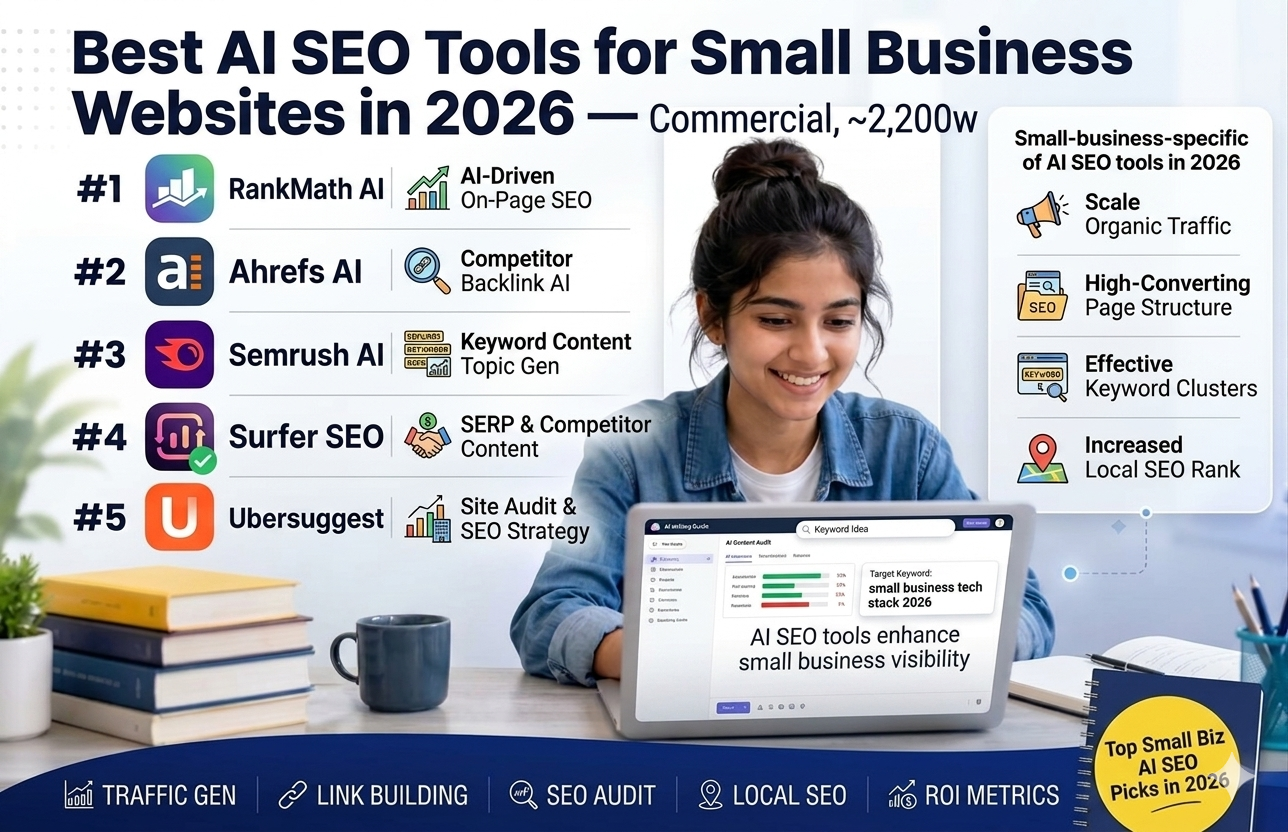
Semrush is the most comprehensive platform on the market and covers nearly every angle of SEO — keyword gaps between you and competitors, backlink analysis, technical site audits, and increasingly, tools for tracking how your brand shows up in AI-generated answers. It’s genuinely powerful, and genuinely more than a lot of small businesses need on day one; it’s the tool worth graduating into once you’re publishing content regularly and want deeper competitive intelligence.
Ahrefs covers similar ground but has built its reputation specifically around backlink data. If link building — getting other reputable sites to link back to yours — is a real part of your strategy, Ahrefs tends to have the edge here over Semrush.
Both platforms run in a similar price range, typically over $100/month, which is worth knowing upfront: they’re not the place to start if you’re SEO-curious but not yet committed. They’re the place to land once SEO is clearly working and you want to invest further.
Content Optimization: Writing Pieces That Actually Rank
This is the category most small business owners actually need first, because the biggest SEO mistake isn’t a technical error — it’s publishing content that never had a real shot at ranking in the first place.
Surfer SEO analyzes the pages currently ranking for your target keyword and tells you specifically what your content needs — word count in the right range, related terms competitors are using, structural patterns like heading count — before you publish. It’s less a writing tool and more an editor that speaks fluent Google. It pairs well with any AI writing tool, since Surfer’s job is scoring and refining, not generating the first draft.
Frase does something similar but starts a step earlier: it researches what’s currently ranking, pulls out the actual questions people are searching alongside your target keyword, and builds a content brief before you write anything. This research step is the part most small business owners skip when they write content solo, and it’s often the actual reason a well-written post doesn’t rank — it just never answered the specific questions searchers had.
Pricing on both varies by plan size, but Frase tends to have a noticeably lower entry point, making it the more approachable starting point if you’re publishing on a modest schedule — a handful of articles a month rather than daily.
Budget-Friendly Picks for Content-First Small Businesses
If your SEO strategy is mostly “publish good blog content consistently” rather than complex technical work, a couple of tools are built specifically for that lighter use case.
RankIQ focuses exclusively on blog content — keyword analysis paired with optimization guidance — and is popular with small business owners and bloggers focused purely on organic growth through steady publishing. It doesn’t do technical SEO or backlink management, but if that’s not your priority yet, that’s a feature, not a limitation — you’re not paying for tools you won’t use.
Ubersuggest is a longtime budget favorite for keyword research and basic site audits, and it’s often paired with a content tool like Frase by small businesses trying to keep their total software spend well under $100/month while still covering the core bases.
Local SEO: A Different Game Entirely
If you run a business that depends on people nearby finding you — a restaurant, a repair shop, a local service provider — general SEO tools miss the specific mechanics that actually matter for local search.
BrightLocal is built specifically around local search visibility: managing your Google Business Profile, tracking local pack rankings (the map results that show up for “plumber near me” type searches), and monitoring citation consistency across directories. If your business lives or dies by local foot traffic or service-area calls rather than broad organic content, this is a more relevant investment than a general content optimization tool, and it’s often paired with just a general AI writing tool like ChatGPT for the actual page content.
The New Frontier: Showing Up in AI Answers, Not Just Google Results
Here’s the part of SEO that’s genuinely different from even a year or two ago, and worth understanding even if you don’t act on it immediately. A meaningful and growing share of people are now getting answers directly from ChatGPT, Claude, and Perplexity instead of clicking through ten blue links on Google — and most small businesses have no idea whether they’re even mentioned in those answers, let alone how to improve it. This practice is sometimes called generative engine optimization, or GEO.
Tools like Otterly and Sight AI have emerged specifically to track this — monitoring how often and how favorably your brand shows up when people ask AI models questions relevant to your business, similar to how a rank tracker monitors your Google position. Otterly, for instance, offers an entry-level plan built around monitoring a set number of prompts, making it accessible for a solo business owner just curious whether they’re visible at all in AI search before deciding whether it’s worth deeper investment.
I’d treat this category as worth watching rather than an urgent must-buy for every small business today — but if your customers are the type to ask ChatGPT “best [your category] near me” instead of Googling it, it’s worth at least running a free or entry-tier check to see where you currently stand.
Full-Automation “SEO Agents”: Proceed With Healthy Skepticism
A newer pitch you’ll see increasingly often is the fully autonomous “AI SEO agent” — software that claims to handle the entire workflow end to end: keyword research, content creation, publishing, and performance tracking, positioned as a replacement for hiring an SEO agency at a fraction of the cost.
The pitch is appealing, and the category is genuinely growing, but I’d apply the same skepticism here that’s healthy for any “fully autonomous” software claim: publishing content to your live site without a human reviewing it first is a meaningfully bigger leap of faith than using a tool for recommendations you still approve. If you’re tempted by one of these, run a trial period where you review everything before it publishes, rather than handing over full autonomy on day one. The cost savings versus an agency are real, but so is the risk of publishing something off-brand or factually wrong at scale before you’ve verified the quality.
A Word on Trust in This Space
Worth saying plainly: an unusually large share of “best AI SEO tools” articles online are published by the tools themselves or by sites with an obvious affiliate relationship to whichever product tops their list — and it shows in how conveniently their own product always lands at number one. That doesn’t automatically make the tool bad, but it does mean you should treat any single ranked list, including this one, as a starting point for your own research rather than a final verdict. Cross-check reviews on independent platforms, and run the free trial before committing to a monthly subscription.
How to Actually Choose, Based on What Kind of Business You Run
If you’re a solo business owner or a small team with a limited budget, start with the free Google tools, add a lighter content tool like Frase or RankIQ once you’re publishing regularly, and revisit whether you need more once that’s working.
If you’re a local service business, prioritize BrightLocal and your Google Business Profile over general content tools — that’s genuinely where your customers are looking.
If you’re running a serious content marketing operation with multiple writers and real competitive pressure, the combination of Semrush or Ahrefs alongside Surfer SEO is the more mature setup worth graduating into, even though it’s a bigger monthly investment.
And regardless of which category fits, don’t skip setting up basic AI visibility tracking at some point this year. It costs very little to check, and the businesses that figure out this shift early are the ones who’ll have an easier time adapting as more of their customers start asking an AI model instead of typing into a search bar.
The Bottom Line
None of these tools do the strategic thinking for you — they still need a human deciding what your business actually wants to be known for. What they do is remove the guesswork: which keywords are worth targeting, what your content is missing compared to what’s already ranking, and increasingly, whether you even show up when people ask AI models for recommendations. Start with the free basics, add one tool that matches your actual bottleneck, and expand from there once you can see it’s paying for itself.