A few years ago I sat down with a friend who runs a small landscaping business — great at his job, terrible at sitting still in front of a keyboard. He needed a “About Us” page, some seasonal email blasts, and captions for the truck photos he was already taking anyway. He told me writing that stuff felt like “homework from a class I never signed up for.” That’s basically every small business owner I know. You didn’t start your business because you love writing product descriptions at 11pm.
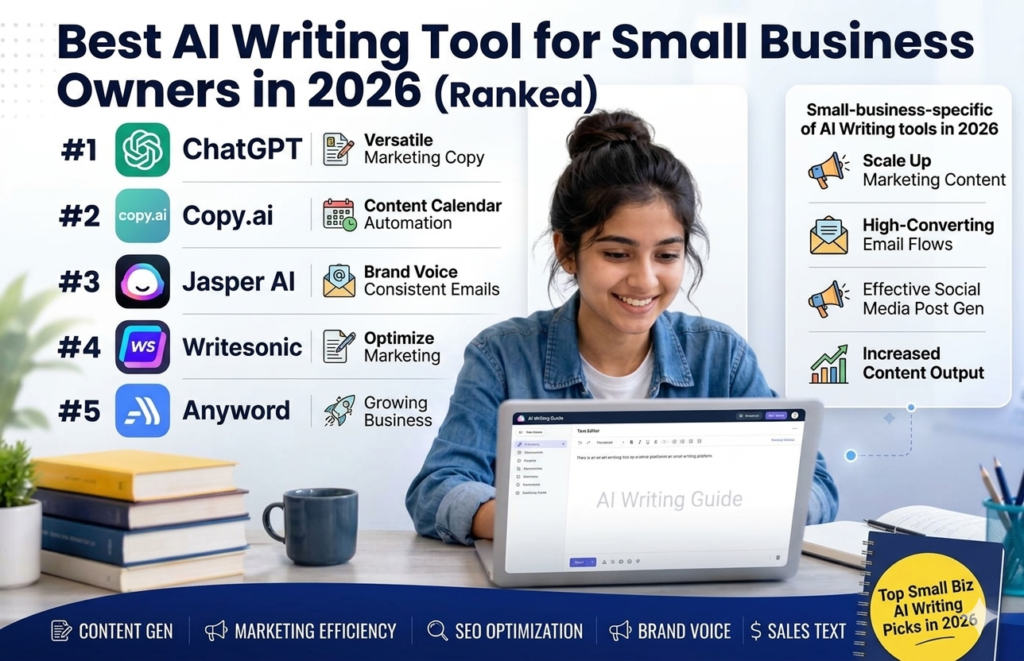
AI writing tools have gotten good enough now that this problem is mostly solved, if you pick the right one for what you actually need. The catch is that “best AI writing tool” isn’t one answer — a bakery owner writing Instagram captions has a totally different need than a consultant writing a 3,000-word lead magnet or an e-commerce store cranking out five hundred product descriptions. So here’s my honest ranking, broken down by what you’re actually trying to get done, not just a generic top-ten list.
How I’m Ranking These
Before diving in, a quick note on trust, because this space is absolutely flooded with affiliate-driven “best of” lists where the writer’s top pick conveniently has the highest commission. I’m ranking these based on three things that actually matter to a small business owner: how much editing the output needs before you’d feel okay publishing it, how steep the learning curve is, and whether the pricing makes sense for a business running on a real budget, not a marketing agency’s budget. Take any single ranking (including this one) with a grain of salt and run your own free trial before committing money.
1. ChatGPT — Best All-Around Starting Point
If you only ever use one AI tool for your business, this is probably still the right default. It’s flexible enough to handle blog posts, emails, product descriptions, social captions, and even help you think through a marketing plan out loud, which is more than most dedicated writing tools can say. The free tier is genuinely usable for a small business just getting started, and the paid plan opens up longer outputs and more consistent quality.
The honest downside: it doesn’t have built-in SEO research or brand voice training the way some purpose-built tools do, so if you’re producing content specifically to rank on Google, you’ll eventually want to pair it with something more specialized. But as a general-purpose writing partner that can flex to whatever you throw at it that day, nothing else on this list is as versatile.
Best for: the owner who wants one tool that does a bit of everything and doesn’t want to manage three subscriptions.
2. Claude — Best for Longer, More Natural-Sounding Writing
I’ll be upfront that I have an obvious soft spot here, but it’s earned one in independent testing too: recent comparisons of AI writing quality have found Claude leads for producing text that sounds like a person wrote it rather than an algorithm, which matters more than people expect. Google actively penalizes content that reads as low-effort AI filler, and the tool that requires the least “humanizing” editing afterward is quietly the one saving you the most time, even if it’s not the flashiest.
Where it particularly shines is longer documents — a full blog post, a detailed FAQ page, an email sequence — where it stays consistent in tone from the first paragraph to the last instead of drifting into repetitive phrasing halfway through. That consistency is genuinely hard for a lot of AI writers to pull off once you get past a few hundred words.
Best for: longer-form content — blog posts, guides, detailed emails — where tone consistency and a natural voice matter more than templated speed.
3. Jasper AI — Best for Brand Voice at Scale
Jasper has built its reputation specifically around letting you train a “brand voice” profile so that whoever’s using the tool — you, an assistant, a freelancer — produces content that sounds consistently like your business rather than like generic AI output. It comes with over fifty templates covering everything from Facebook ads to product descriptions, which is genuinely useful if you’re producing a high volume of varied content types and don’t want to reinvent your prompt every time.
The tradeoff is price. Jasper sits solidly in the mid-to-premium tier, typically starting somewhere around $39/month, which is a real number for a small business rather than a rounding error. It’s worth it if you’re publishing consistently and multiple people touch your content. It’s probably overkill if you’re a solo owner writing one newsletter a month.
Best for: businesses with more than one person writing content who need everything to sound like it came from the same brand.
4. Copy.ai — Best Free Plan
If budget is the deciding factor — and for a lot of small businesses, it genuinely is — Copy.ai’s free plan gives you a real amount of usable output (around 2,000 words a month with no card required) before you have to pay anything. That’s enough to cover a handful of social captions, an email, or a short product description each month while you figure out whether AI writing is actually going to become part of your routine or just another subscription you forget to cancel.
It doesn’t have the deep SEO research tools of something like Frase or Surfer, and the free tier will feel limiting fast once you’re publishing more than occasionally. But as a genuinely no-risk way to test the waters, it’s hard to beat.
Best for: testing whether AI writing fits your workflow before you spend a dollar.
5. Rytr — Best Budget Pick for Regular Use
Once you’re past the testing phase and know you’ll use an AI writer regularly, Rytr is the tool most often recommended specifically for its price-to-usefulness ratio, starting around $9/month for full-featured short-form writing. It covers the bread-and-butter small business needs — blog posts, emails, social media, product descriptions — without the premium price tag of Jasper or the steeper learning curve of the more SEO-heavy tools.
It’s not going to out-write Claude or ChatGPT on a genuinely long, nuanced piece, and the interface is simpler with fewer customization options than the pricier platforms. But for the actual day-to-day content a small business needs — a weekly email, a product listing, a caption — it punches well above its price.
Best for: the owner who wants a reliable, cheap workhorse for routine writing tasks, not ambitious long-form content.
6. Writesonic — Best for Content Marketing Volume
If your business is trying to build out a real content marketing engine — regular blog posts aimed at ranking on Google, alongside social and email — Writesonic is frequently the pick for businesses trying to scale output without scaling headcount. It handles a wide range of formats and is built with a content-marketing workflow in mind rather than just one-off writing tasks.
Best for: small businesses actively trying to grow through content marketing rather than just keeping up with occasional writing needs.
7. Frase — Best for SEO Research Before You Write
Most AI writing tools skip the research phase entirely and jump straight to generating text, which is exactly the gap Frase fills. It analyzes what’s already ranking for your target keywords, pulls out the questions people are actually searching for, and builds a content brief before you write a single word — then scores your draft against top-ranking competitors as you go.
This matters more than it sounds like. A lot of small business owners publish AI-written content that reads fine but never ranks, because it never answered the actual questions people were searching for in the first place. Frase’s research step fixes that specific problem, though it’s a better fit once you’re serious about SEO rather than just trying to keep your blog from looking abandoned.
Best for: businesses that care about ranking on Google, not just publishing content.
8. Surfer SEO — Best Pure Optimization Layer
Surfer isn’t really a writing tool on its own — it’s an optimization layer that scores your content against what’s currently ranking and tells you specifically what to add, cut, or restructure. Paired with Jasper or another writer, it’s a genuinely strong combination for content built specifically to compete for search traffic. On its own, without something generating the actual draft, it’s less useful for a small business just looking for a simple writing assistant.
It also sits at a higher price point, typically starting around $99/month, which makes it a tool worth adding once content marketing is a real growth channel for you, not a starting point when you’re just trying to get your first blog post published.
Best for: pairing with a drafting tool once SEO becomes a real priority.
9. Grammarly — The One Everyone Should Have Anyway
Grammarly isn’t generating your content, but I’m including it because it’s the cheapest insurance a small business can buy against publishing something with an embarrassing typo or a sentence that reads like it was translated twice. It polishes whatever you or another AI tool produces, catching grammar issues, tone inconsistencies, and clarity problems before anything goes live under your business’s name.
Run everything through Grammarly as a last step regardless of which primary writing tool you pick. It’s the one item on this list that’s less “which one should I choose” and more “just have this running in the background.”
Best for: a final polish pass on anything you’re about to publish, no matter which tool wrote the first draft.
What I’d Actually Tell a Friend
If you’re just starting out and unsure whether AI writing is even going to stick as part of your routine, start with ChatGPT’s free tier or Claude’s free tier and just use it for two weeks on real tasks — not test prompts, actual emails and captions you need to send anyway. See how much editing the output needs before you’re comfortable publishing it. That’ll tell you more than any ranked list, including this one.
If you land on “yes, this is actually saving me time,” then decide what you’re optimizing for: consistency of brand voice across multiple people (Jasper), cheap reliable volume for routine content (Rytr), or a genuine content marketing push aimed at ranking on Google (Writesonic or Frase, ideally paired with Surfer).
And whatever you pick, don’t skip Grammarly as a final pass, and don’t publish the very first draft an AI tool hands you. The businesses that get burned by AI writing aren’t the ones using it — they’re the ones publishing the raw output without reading it first. The tool saves you the blank page. It doesn’t replace you actually caring about what goes out under your name.

Comments