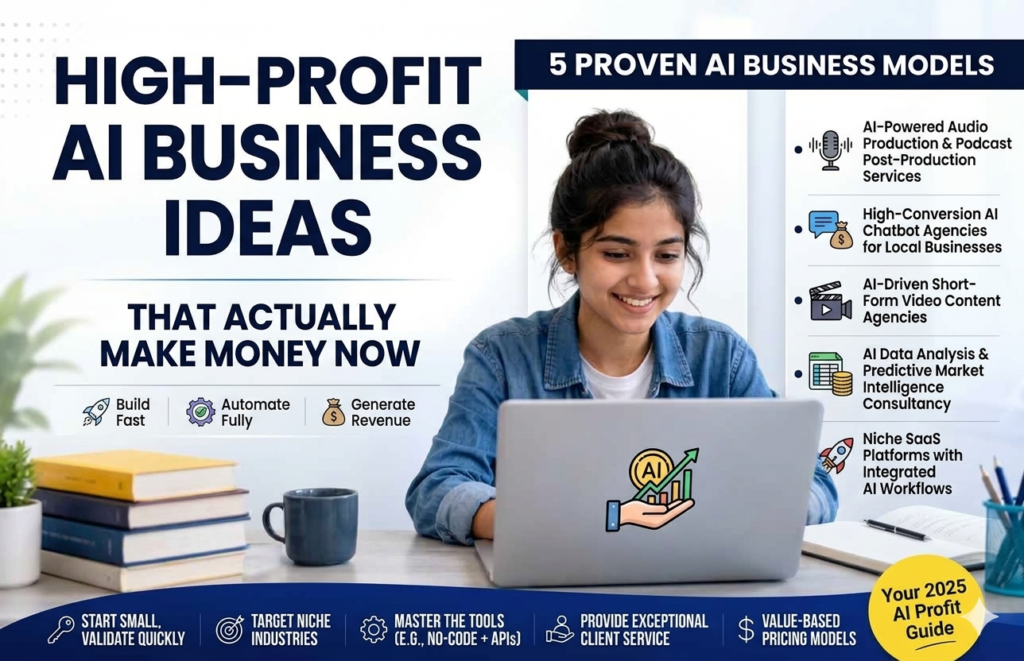
Every few months I see another “50 AI business ideas!” list promising six figures a month from something you can supposedly launch this weekend. Most of it is noise. The AI business ideas that actually make money in 2026 aren’t secret — they’re just less exciting than the headlines: solving a specific, recurring problem for a specific type of customer, using AI to do it faster or cheaper than the alternative, and then doing the unglamorous work of finding clients and keeping them.
None of what follows is a guarantee — how much any of these earns depends entirely on how well you execute, how competitive your niche is, and how much real work you put in beyond “set up the tool.” But these are the categories where the demand is genuinely there and the AI tools have matured enough to make a solo person or small team competitive with businesses far bigger than them.
1. AI-Powered Content Services for Businesses That Don’t Have Time to Do It Themselves
Content marketing hasn’t gone away — if anything, demand for it has grown, since a majority of businesses are now actively planning to spend more on it. What’s changed is that a single person with the right AI writing and design tools can now produce what used to take a small content team, which makes this a genuinely viable service business for one person or a tiny agency.
The businesses that succeed here don’t sell “AI-generated content” — they sell reliable, on-brand output on a schedule, using AI to do the heavy lifting and their own editing and strategy to make it actually good. Blog posts, email newsletters, social captions, and product descriptions are the easiest entry points because the deliverables are well understood and easy to price.
Getting started: A general AI assistant plus a tool like Jasper or Canva AI, a handful of case studies (even from your own test projects), and outreach to a specific niche rather than “everyone.”
2. AI Workflow Automation for Small Businesses
Most small businesses are still doing something manually that could be automated — copying data between a spreadsheet and their invoicing tool, manually following up with leads, re-typing information from one system into another. Tools like Zapier and Make.com make it possible to fix these problems without writing code, but plenty of business owners don’t have the time or patience to figure out how to build the automation themselves.
That gap is the business: you audit a client’s repetitive tasks, build the automation for them, and either charge a flat setup fee or a small ongoing retainer to maintain it. It’s unglamorous work, but it solves a problem business owners feel every single day, which makes it an easier sell than something more abstract.
Getting started: Learn one automation platform deeply rather than several shallowly, and start with businesses you already have a relationship with — this is a trust-based sale, since you’re touching their actual business systems.
3. AI Customer Support Setup for Small Businesses
A lot of small businesses know they’re losing time (and probably sales) to slow response times on repetitive customer questions, but don’t have the technical know-how to set up an AI chatbot themselves. Building and configuring that — training it on their FAQ, connecting it to their website or messaging channels, and tuning it so it actually sounds like their business — is a service, not just a piece of software.
This works particularly well for e-commerce and local service businesses, where the questions are genuinely repetitive (shipping times, booking availability, pricing) and the AI tooling for chatbots has gotten good enough that the setup is the hard part, not the technology itself.
Getting started: Pick one chatbot platform (Tidio is a common, accessible starting point), build a portfolio piece for a business you know, and price around the time and headache you’re saving them rather than around the tool’s sticker price.
4. Niche AI Consulting — Not “AI Strategy,” a Specific Industry Problem
“AI consultant” as a generic title is oversaturated and vague. What’s actually working is domain-specific: someone who deeply understands one industry — dental practices, independent law firms, boutique real estate agencies — and knows exactly where AI tools fit into how that specific business runs. You’re not selling AI expertise in the abstract; you’re selling “I know your industry, and I know how to make AI actually useful in it.”
This tends to pay better than generic content or automation services because you’re selling judgment, not just execution — and it’s harder for a client to easily replace you with a cheaper alternative once you understand their business.
Getting started: Pick an industry you already have some credibility in (from past work, a network, or direct experience), and start by solving one visible problem for one client rather than pitching a full “AI transformation.”
5. Building a Narrow AI Tool for One Specific Job
Not every AI business idea has to be a service you deliver personally. Plenty of profitable small AI products in 2026 are narrow, purpose-built tools that do one specific job for one specific type of customer — not a general-purpose platform, just a focused wrapper around existing AI models solving one annoying, recurring problem well.
The realistic path here isn’t “build the next big AI platform” — it’s “build the smallest possible tool that fixes one specific, recurring headache for a niche audience you understand.” Think a tool that turns podcast transcripts into show notes for indie podcasters, or one that generates property listing descriptions for small real estate teams. You don’t need to train your own model — nearly all of these are built on top of existing AI APIs.
Getting started: This one has real technical or no-code-platform requirements (tools like Bubble or similar app builders can lower the bar). Validate the specific problem with real potential customers before you build anything.
6. AI-Assisted Freelance and Productized Services
If you’re already a freelancer — a writer, designer, virtual assistant, bookkeeper — AI tools can meaningfully increase how much work you can take on without dropping quality, which either means more clients at the same rate or the same clients at a better margin. Some freelancers are going further and “productizing” this: turning a custom service into a fixed-price, fixed-scope package (e.g., “five blog posts a month, delivered every Monday”) that’s fast to deliver because AI handles the first draft.
This isn’t a new business model, but AI is what makes the math work better than it used to — the same hour of your time now produces meaningfully more finished output.
Getting started: If you’re already freelancing, this is the lowest-risk idea on this list — you’re not starting from zero, you’re making your existing service faster and more scalable.
7. Faceless Content Channels and Niche Digital Products
AI-assisted content channels — YouTube, newsletters, social accounts built around a specific niche rather than a personal brand — remain a viable, if crowded and slower-to-monetize, path. The honest version of this idea isn’t “AI writes everything and money appears.” It’s using AI to handle the production grind (scripting, editing, repurposing one piece of content into five formats) while you focus on the actual strategy: picking a niche with real, underserved demand and being consistent for months before it pays off.
This is the idea on this list I’d caution people about most — it’s oversaturated with low-effort content, and the accounts that actually make money are the ones treating it like a real content business with a specific audience in mind, not a volume play.
Getting started: Pick a genuinely narrow niche, commit to a realistic publishing schedule you can sustain using AI for the repetitive parts, and expect months before it becomes real income.
The Honest Throughline
Every idea on this list works the same way: find a specific, recurring problem a specific type of customer already has, use AI to solve it faster or cheaper than the existing alternative, and then do the actual business work — finding customers, delivering reliably, and keeping them — that AI doesn’t do for you. The tool is never the business. It’s the thing that makes a smaller team able to compete with a bigger one, not a replacement for actually understanding who you’re selling to and why they’d pay you instead of doing it themselves.
If you’re evaluating any of these, the same test applies every time: can you name a real person or business who has this problem right now and would pay to have it solved? If yes, that’s worth testing. If the honest answer is “probably someone, somewhere,” that’s a sign to narrow the idea further before you build anything.

Comments