I’ve managed Google Ads accounts through a lot of “this changes everything” moments ,the shift to Smart Bidding, the Performance Max rollout, the keyword matching mess of the last few years. Most of those moments were overhyped. This one isn’t.
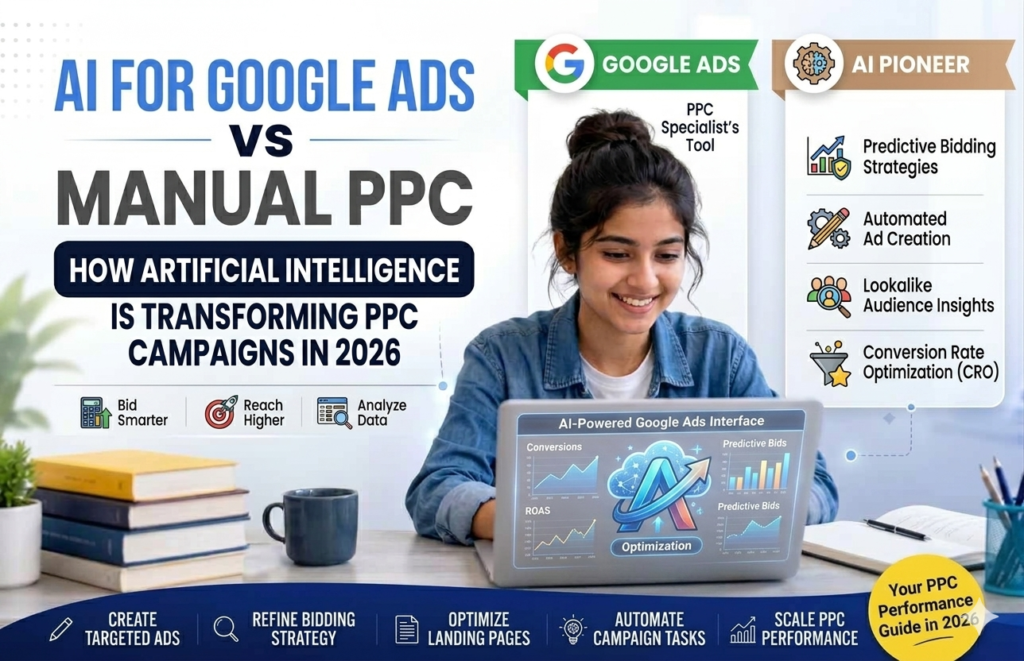
2026 is the first year where the account manager’s actual job has changed shape. You’re not bidding manually anymore, and you’re increasingly not even writing the ads yourself. Your job is feeding the machine good information and catching it when it’s wrong. That’s a real shift, and if you’re still running campaigns the way you did in 2023, you’re leaving money on the table — or worse, quietly overpaying for clicks that used to be cheap.
Here’s what’s actually happening under the hood, and what to do about it.
AI Max Is Basically Eating Search Campaigns
If you haven’t heard of AI Max yet, you will soon whether you like it or not. It’s Google’s newer campaign layer for Search that automatically expands keyword matching, rewrites your ad text on the fly, and can even expand your final URLs to send traffic to the most relevant page on your site — all without you touching a thing.
The part that surprised a lot of advertisers: Google isn’t leaving this optional forever. Starting in September, Dynamic Search Ads campaigns are being automatically upgraded to AI Max, with settings configured to mirror the old setup, search term matching, text customization, and final URL expansion all switching on with legacy URL controls preserved. Campaign-level broad match users are getting the same treatment, with search term matching enabled by default.
If you’ve been avoiding AI Max because you like your tightly controlled match types, you’re running out of runway. My advice: don’t wait for the forced migration. Turn it on for one lower-stakes campaign now, watch the search terms report closely for a couple of weeks, and build your negative keyword habits around it before it becomes mandatory everywhere else.
There’s also a genuinely useful new addition here worth knowing about: Google introduced an “AI Brief” tool built on Gemini that lets you steer AI Max in your own words,describing your business, your intended messaging, and who you actually want to reach, instead of hoping the algorithm figures it out from your keyword list alone. It’s the closest thing yet to actually “briefing” the AI the way you’d brief a junior copywriter.
Performance Max Finally Grew Some Guardrails
Performance Max has been a love-hate relationship for most advertisers since launch. You handed Google your budget and your assets, and it optimized across Search, Shopping, Display, YouTube, Discover, Gmail, and Maps — with almost no visibility into where your money actually went. It worked shockingly well for some accounts and burned budget for others, and you had almost no way to tell which one you’d get.
That’s changed a lot this year. Advertisers now have channel-level performance reporting, campaign-level negative keywords, and better placement exclusion controls that simply didn’t exist before. Google has also rolled out first-party audience exclusions, so you can keep your acquisition budget focused on new customers instead of re-targeting people already in your database.
The honest way to think about this: PMax went from “autopilot with the windows blacked out” to “autopilot with a dashboard.” The automation is still doing the heavy lifting, but you can finally see what it’s doing and correct it when it’s wrong. If you gave up on PMax in 2023 or 2024 because it felt like a black box, it’s worth a second look now — but go in checking that reporting weekly, not quarterly.
AI Is Now Making Your Actual Ad Creative
This is the part that feels the most like science fiction if you haven’t touched Google Ads in a year or two. Google has been rolling out increasingly capable image generation directly inside the platform, including a newer image model nicknamed “Nano Banana Pro,” aimed at giving advertisers polished ad visuals without a design team.
Beyond Google’s native tools, a whole ecosystem of third-party AI creative tools has grown up around this. Platforms in this space now offer things like automatic scoring of which ad creative variants are likely to convert best, based on patterns learned across huge numbers of past campaigns, and continuous testing systems that quietly retire the losing variants and keep the winners running without anyone manually checking a dashboard.
If you’re a small business running your own ads, this matters even if you never touch these tools directly, because your competitors are using them to test five ad variations for every one you’re running. The floor for “good enough” creative just went up.
Smart Bidding Isn’t New, But What’s Feeding It Is
Automated bidding strategies like Maximize Conversions, Target CPA, and Target ROAS have been around for years, adjusting bids in real time based on signals like device, location, time of day, and user intent. What’s changed in 2026 isn’t the bidding math, it’s the richness of the signals going into it, and how much of the surrounding workflow now runs on autopilot alongside it.
The practical upshot for small business owners: if your conversion tracking is sloppy, or you’re not passing back real revenue data (not just lead counts) to Google, you’re feeding a very smart system bad information, and it will make confidently wrong decisions with your budget. This is more important now than it was two years ago, not less, because the AI is trusting your data more and second-guessing it less.
The Tools Actually Worth Paying For
There’s now a real market of AI-powered PPC management tools built to sit on top of Google Ads, mostly aimed at agencies and businesses spending enough that manual oversight doesn’t scale. A few categories worth knowing about:
- Account health monitors that scan your campaigns for dozens of common issues — conflicting negative keywords, broken landing page URLs, budget pacing problems — and flag them before they quietly drain your spend.
- Negative keyword discovery tools that specifically hunt through Performance Max search term data (which used to be nearly invisible) to find irrelevant queries eating your budget.
- Autonomous management platforms that go a step further and actually execute bid, budget, and negative keyword changes around the clock instead of just suggesting them, which is a meaningful shift from the “recommendations dashboard” model most tools used a few years back.
None of these replace understanding your own numbers. They replace the 15-20 hours a week a lot of PPC managers used to spend on repetitive account maintenance, which is genuinely a big deal if you’re a small business owner running ads yourself alongside everything else you do.
What This Means If You’re Running Ads for a Small Business
You don’t need to become a machine learning expert to benefit from any of this. You need three things in place:
- Clean conversion tracking. All of this AI is only as good as the data you feed it. If you’re not tracking real conversions (and ideally conversion value), fix that before you touch anything else on this list.
- A weekly check-in habit, not a “set it and forget it” mindset. The new reporting and controls only help if someone’s actually looking at them. Automation removes grunt work, not oversight.
- A point of view on your own brand and audience that you can feed into tools like AI Brief. The AI is powerful, but it still needs to know who you’re trying to reach and what you actually want to say to them — that part hasn’t been automated away, and I don’t think it will be anytime soon.
The Bottom Line
The advertisers doing well with Google Ads in 2026 aren’t the ones who resisted AI the longest, and they’re not the ones who blindly trust the automation either. They’re the ones who figured out which parts of the job the AI genuinely does better than a human (bid adjustments in real time, generating creative variants, catching wasted spend at 3am) and which parts still need a person paying attention (strategy, brand voice, catching the AI when it’s confidently wrong).
That combination ,not the tech by itself , is what’s actually driving better campaign performance this year.

Comments